How Close Were They?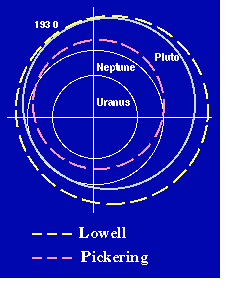 Both
Percival Lowell and William Pickering had spent a lot of time and energy
calculating the position of the ninth planet. With its orbit now established,
we can see how close they really were. Both
Percival Lowell and William Pickering had spent a lot of time and energy
calculating the position of the ninth planet. With its orbit now established,
we can see how close they really were.
Although Tombaugh had finally decided to ignore Lowell's predictions, and set about examining the whole sky, Pluto was discovered within six degrees of where Lowell and Pickering had independently predicted it to be. This diagram is from Dennis Rawlin's article "The Mysterious Case of Planet Pluto," (Sky & Telescope, March 1968). It shows Pluto's actual orbit compared to its calculated orbit. (The Pickering orbit is from his 1928 calculations.) In 1930, when Pluto was discovered, Lowell's orbit comes remarkably close to Pluto's, as shown in the upper left quadrant of the diagram. However, location was not the only part of their calculations. Mass, distance, period, and other orbital elements were duly predicted by the two astronomers. The table below compares their numbers with Pluto's actual elements.
     Orbital Elements      Lowell     Pickering       Pluto
     Mean distance (AU*)   43.0          55.1          39.5
     Eccentricity          0.202         0.31          0.248
     Inclination           10 degrees    15 degrees    17.1 degrees
     Perihelion date**     Feb 1991      Jan 2129      Sept 1989
     Period (years)        282           409.1         248
     Mass (Earth=1)        6.6           2.0           < 0.7
*Astronomical Unit: the mean distance from the Earth
to the Sun;149,597,893 kilometers. The accuracy of their predictions is remarkable when considering two facts: 1) They made their calculations based on perturbations in the orbit of Uranus, and 2) Pluto does not have the mass needed to affect Uranus's motion. If Pluto was not Lowell's Planet X, its discovery marks one of the most incredible coincidences in the history of science.
|